
Picture Credit: RYIM Mumbai team
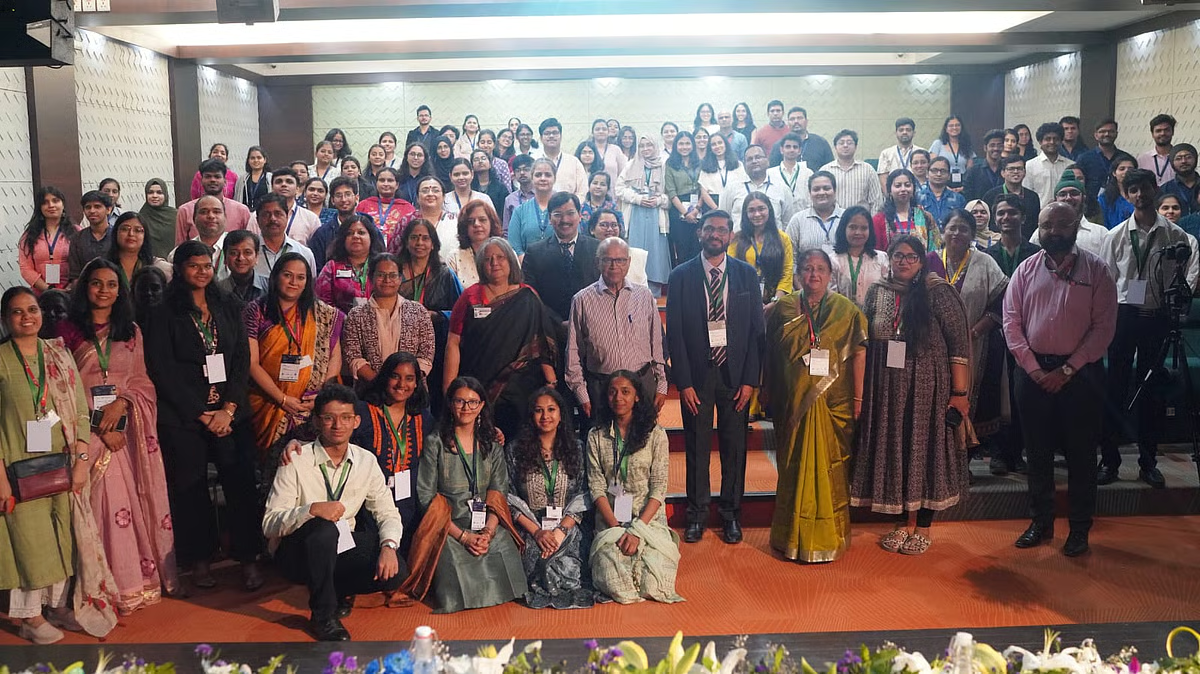
The Regional Young Investigators’ Meeting (RYIM) Mumbai 2025 was held on 4 – 5 December 2025 at SVKM’s Mithibai College, Mumbai, in collaboration with the Gujarat Biotechnology University, and Kishinchand Chellaram College, HSNC University. The meeting brought together 112 participants, including young investigators, faculty, postdoctoral fellows, research scholars, clinicians, and industry professionals.
Hosted at a state-funded institution and strengthened through partnerships with academic organizations across western India, RYIM Mumbai brought together colleges and a university united by a shared vision to foster interdisciplinary research. The meeting created a much-needed platform for early-career researchers and students to access mentorship, build networks, and cultivate aspirations that are often limited by institutional boundaries. RYIM Mumbai advanced pathways to interdisciplinary research by encouraging collaboration across institutions and by increasing awareness of research careers and funding opportunities among young scientists.
Organizing RYIM Mumbai at Mithibai College highlighted the impact of embedding high-level scientific conversations within teaching-oriented institutions. For many attendees—particularly postgraduate students and early-career faculty—this was their first sustained interaction with researchers from leading institutions such as TIFR, ACTREC, centrally funded research centres under ICMR and ICAR, and representatives from industry. This experience reflected a broader national context, where state-funded colleges possess strong teaching environments but often remain disconnected from national research ecosystems. Through direct engagement with funded researchers, participants gained valuable insights into navigating India’s research funding landscape.
Engagements with undergraduate and postgraduate students, as well as faculty from Mithibai and neighboring colleges, were especially enriching. The interactive “Ask Us Anything” session stood out as a highlight of the meeting.
“The interactions were extremely meaningful, and the ‘Ask Us Anything’ session was truly the cherry on top,”
— Tejal Gajaria, Navrachana University, Gujarat; young investigator and RYIM Mumbai participant
Panel discussions and hands-on workshops centered on collaboration, leadership, and career development added depth to the conversations. The success of this format suggests its potential to bridge the persistent divide between research-intensive institutions and colleges that are actively building research capacity. The Mumbai meeting strongly aligned with IndiaBioscience’s broader goal of expanding platforms like YIMs and RYIMs to reach diverse academic settings. Importantly, it demonstrated how sustained regional engagement—through repeated meetings and follow-up initiatives—can integrate perspectives on mentorship, funding, and career growth into India’s evolving scientific community.
Science beyond borders: Enabling collaboration across disciplines
Reflecting the meeting’s central theme, the panel on “Collaboration as a catalyst for scientific progress” emphasized the shift from isolated research to interconnected ecosystems driven by shared resources, interdisciplinary approaches, and external partnerships. Panelists encouraged early-career researchers to view collaboration as a mindset rather than a procedural requirement. They highlighted how regional meetings like RYIM provide accessible entry points to collaborative projects and enable researchers to leverage national funding schemes that support innovative, high-risk ideas. The discussions reinforced that readiness for interdisciplinary research depends as much on culture as on infrastructure.
Picture Credit: RYIM Mumbai team
Mentorship from across India’s research landscape
Over two days, participants interacted with mentors from leading research institutions, hospitals, funding-associated centers, and industry incubators. Sessions explored formulating locally relevant research questions, translating basic science into application, ethical publishing practices, research visibility, and the expanding role of AI, bioinformatics, and data-centric science. These interactions helped make research careers more transparent and approachable, especially for participants from teaching-focused colleges.
Day 2 concluded with India Bioscience’s Crafting Your Career (CYC) workshop, which guided participants through self-assessment of skills, interests, and values while introducing diverse science career pathways—including academia, industry, entrepreneurship, and science communication. Interactive exercises and peer discussions encouraged participants to actively reflect on their professional journeys and develop transferable skills such as communication, networking, and professionalism.
Exposure to mentors connected with funding agencies further helped participants see research careers as structured and attainable rather than inaccessible.
Building sustained partnerships for the future
For India Bioscience, RYIM Mumbai reaffirmed the value of engaging institutions on their own ground and supporting long-term capacity building through visibility, connections, and continued engagement with India’s scientific ecosystem.
Beyond the formal programme, the meeting facilitated direct discussions with college leadership on potential future initiatives, including capacity-building workshops for young investigators and undergraduate and postgraduate students. These conversations underscored how RYIMs can act as gateways to sustained institutional partnerships rather than being one-off events.
As India Bioscience plans to expand RYIMs to additional cities and institutions, the Mumbai meeting offered key insights into the importance of engaging state-funded colleges. By broadening access to mentorship and research networks, promoting cross-institutional collaboration, and supporting early-career researchers in under-resourced environments, such engagements can play a transformative role in strengthening India’s scientific community.
Watch the complete recordings of the event here and here.
Explore the RYIM Mumbai 2025 abstract book here.