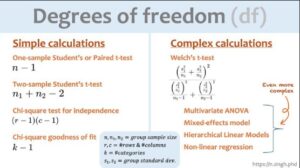
Simply put, df equals the number of values in a constrained system that are free to vary. Note that it only applies to constrained systems. There are many ways to grasp this concept, but here is my understanding.
Imagine I give you five balls, each a different color, and ask you to put them all into a box one at a time in any order. At first, you have many choices for the order. I can’t predict which ball you’ll pick first, second, third, or fourth. However, once you’ve put four balls in the box, your choices are gone—your earlier choices automatically decide the fifth ball. In other words, you effectively had only four independent choices or degrees of freedom. You can replace the balls and box with anything from your domain—wheat varieties, medications, survey samples, etc.
More generally, there are n-1 degrees of freedom, where n is the number of values that go into a calculation. This is the basic idea, however, there is variable complexity with which the df can be calculated to account for the unequal variance, sample sizes, number of parameters, etc.
The df can be calculated as simple as:
🔹n-1 for one-sample student’s t-test
🔹k-1 for chi-sq goodness of fit, where k is the number of categories, etc.
But it can also be as complicated as in:
🔹Welch-Satterthwaite t-test
🔹Multivariate ANOVA
🔹Mixed-effects models, etc.
No matter how simple or complex, they are very important because they determine how we compare our calculated test statistics against their theoretical counterparts to make inferences about our data. They choose the shape of the distributions. Take a look here at how changing df can change the shape of the t-distribution https://lnkd.in/gW6FYq_u